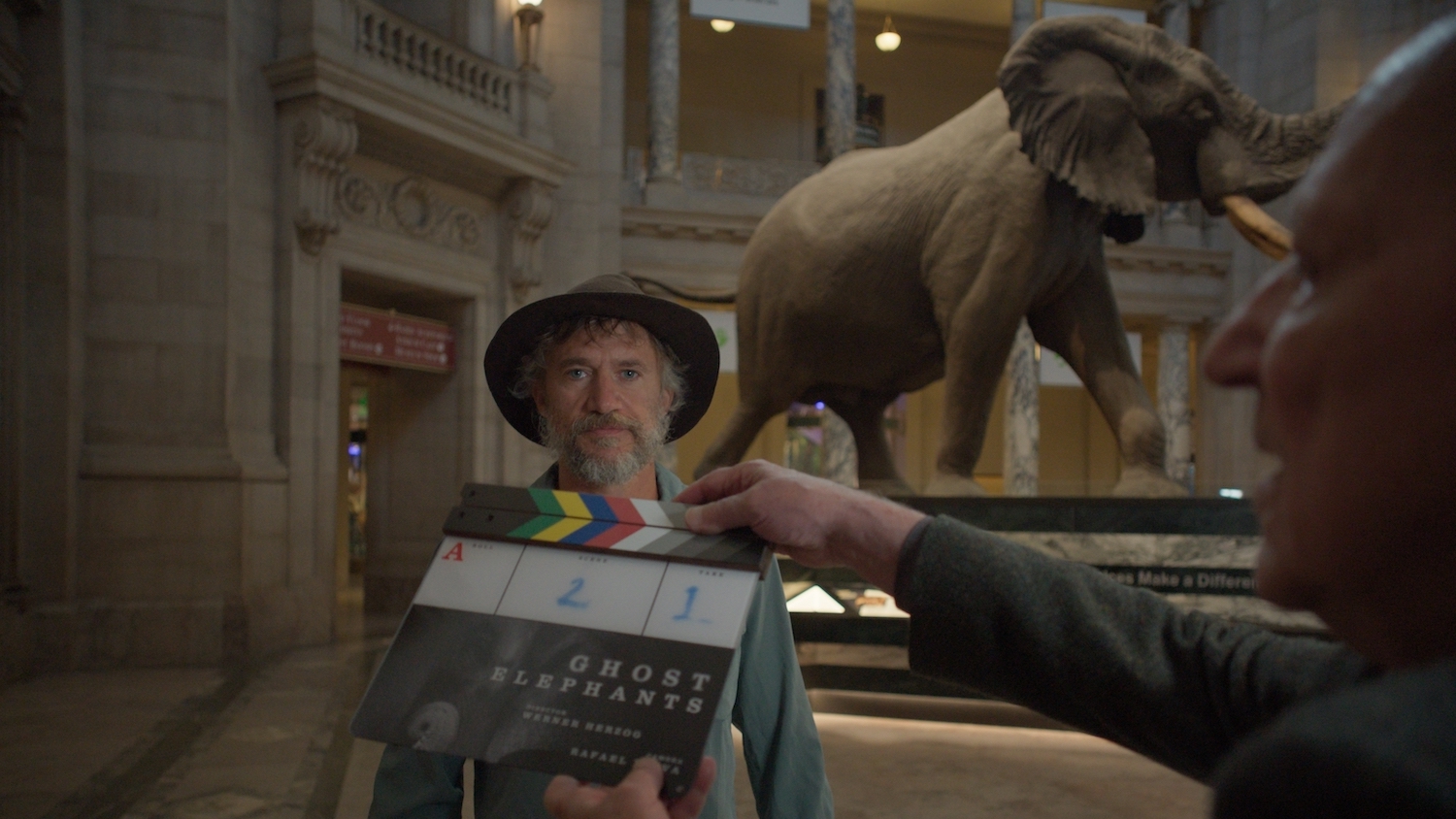
From World Wildlife Day on Tuesday, 3 March, DStv has been bringing the outdoors into your house, with world-class nature documentary series and films. The jewels in the crown are Werner Herzhog’s Ghost Elephants on National Geographic Wild, and the David Attenborough-narrated series Kingdom on BBC Earth.
We chatted to South African National Geographic explorer Dr Steve Boyes – leader of the National Geographic Okavango Wilderness Project – about his years-long search for Angola’s elusive ghost elephants, his partnership with KhoiSan master trackers Xui, Xui Dawid, and Kobus, and more.
Get DStv Start streaming
Watch Ghost Elephants on Wednesday, 11 March at 6PM on National Geographic Wild Channel 182.
And scroll down to find out how the BAFTA-winning BBC Studios Natural History Unit documentary team kept track of which lions, leopards, wild dogs and hyenas were which, while they spent five years working on bringing us Kingdom’s Game of Thrones-style story of lovers, rivals, rises and falls in Zambia’s South Luangwa National Park.
Watch Kingdom Season 1 from Monday, 16 March at 8PM on BBC Earth Channel 184. Available on Catch Up.
Tracking ghost elephants
In Ghost Elephants, the Regedor Kaketche (Mwene Chivueka VI, king of the Luchazi) tells Dr Steve Boyes the origin story of the Nkangala people, which is the tale of the prince and the elephant woman. But it has an ending that’s not in the film, in which the elephant woman takes her husband back to meet her family.
Steve reveals, “The way he (the Kaketche) describes it, they follow exactly the routes in the areas where we were looking, where we found that bull elephant. She goes to this clearing, and he says, ‘Well, there's nothing.’ She cries and takes her tears and paints them on his eyes. He opens his eyes, and all of these elephants arrive in the clearing, and they all take their skins off, and they are people. He stays with them for a time. And then she says, ‘It's time. We must go back now. We must leave.’ And she cries. When she smears tears on his eyes, he opens them, and it's just the clearing again.”
“That's the reflection on the statement at the end of the film: if we were to lose elephants on planet Earth, then it's probably the end of us too. Life will go on, but without us,” explains Steve. “As Werner says, ‘If it was, one day, the search for the last elephant, a ghost in the last forest, we would have done so much wrong that it would be our end too.’”
Even if Dr Steve Boyes had never found his ghost elephants, though, his eyes would still have been opened. “The elephants took us on this extraordinary journey into the remotest parts of this landscape. And look what we found with the Luchazi, Chokwe and Mbundu hunters that we partnered with! We got to meet kings and gain their trust so much that they spoke to their ancestors, and the ancestors let us see the elephants. So much so that the king told us the origin story of the Nkangala, and he has now become a close friend and a collaborator on our conservation work, and our work to protect that landscape with them.”
Scroll through for seven more behind-the-scenes secrets…
Learn more about ghost elephants
San master trackers meet Werner Herzhog
“Werner barreled in with the camera! His first question to Xui was, ‘What would a world be like without elephants?’ And ‘What do you dream?’ They could see that he was in a dreamscape mindspace, which is different from the professional hunters who just talk to them about cars and hunting. They also saw a respected elder, because they could see our behaviour around him. So their interaction was respectful. He and Xui hit it off straight away,” says Steve.
Steve stares down Werner’s lens
“It was intense!” says Steve. “My first interview was at that baobab where I talk about the elephant footprint. It was about two hours past sunset, and none of that is in the film. It took three hours. He was bent down, face next to the camera like a conductor, and it was an exploration of what my dreams are. What's the future of wildlife? I started to realise in that interview that maybe the best part is almost over.”
So much more than elephants
“Along the way, (we were) seeing hundreds of new species to science,” says Steve. “It was always elephants underlying that. Like, why on Earth aren't we seeing the biggest ones? We’re seeing the new populations of wild dogs and cheetahs and leopards and this yellow-backed duiker from the Congo that shouldn't be here. These Gambian sun squirrels. Always finding these things and elephants were just this thing below it, so significant at the end.”
Master trackers are rarer than elephants
Kobus, Xui and Xui Dawid’s village headman showed incredible trust to Steve and Werner by allowing them to go on this journey. If they were to come to harm, Steve believes, “It would be an irreversible loss. Kobus is special because he's training to be a healer and a master tracker. He lives between both worlds. And Xui and Xui Dawid are some of the last bow hunters remaining. There are three more in Botswana. We're talking five bow hunters.”
Tourism is a two-edged sword
“In Botswana and Namibia, you would assume that traditional knowledge systems would be protected. And it's the opposite,” says Steve. “Tourism has become the greatest threat to the Juǀʼhoansi culture, the Basarwa, the Bukakhwe and the Okavango Delta, because the healers and the bowhunters are taken into tourism camps to do tourist activities, to do dances for the tourists, and to take them on bush walks. And that takes them away from training the next generation.”
Knowledge is an endangered species
“The most endangered human resource on the planet is indigenous knowledge systems. That's our backup plan, not Mars,” insists Steve. “What we are supporting is the establishment of spaces that are just for healing, and just for instruction on tracking and bowhunting. Places like Nyae Nyae Conservancy, where three of them come from, and Nhoma are important to that, and we'll create additional spaces in Botswana for it.”
The Regedor Kaketche’s promised knife
As promised, Steve brought the king of the Nkangala a bigger sword, which he had had custom-made. And that was not a frivolous request. “I took it to him in October, wrapped in a blanket. It took an hour and a half to get into the audience and then to update him. I don't think I've got the sacred geometry right, but he was over the moon about it … it's used to cut the air between disagreements and to solve problems.”
Inside Kingdom
Filmed over five years in the Nsefu region of Zambia’s South Luangwa National Park, this six-part series from the BAFTA -winning BBC Studios Natural History Unit documentary is narrated by Sir David Attenborough, and follows the intersecting lives of four rival animal clans led by Olimba the leopard, Storm the wild dog, Tenta the hyena, and Rita the lion. It’s a clash of queens!
“It’s high drama – it's got a bit of Game of Thrones, it's got a bit of Succession, but it's also got a bit of The Lion King,” promises executive producer Mike Gunton. “You're constantly caught in this rollercoaster of shifting power dynamics … It's a bit like watching the top of the Premier League, like a leaderboard of who's winning and who's losing.”
Scroll through for four fun behind-the-scenes details:
Learn more about Kingdom
Local experts at work
“It can be quite a white-knuckle ride at times, but there are also some wonderful moments of beauty and tenderness,” says executive producer Mike Gunton. “We worked closely with the local scientists and conservationists (over 170 people contributed, including over 90 local Zambian crew members and wildlife experts). A lot of them have been there for generations, so they know all the stories. That gives us a huge advantage in figuring out what’s going on between these four families.”
An elephant wrecked our toilet!
Over the course of five years filming, the crew had plenty of close encounters with wildlife. An elephant destroyed one of their bathrooms, someone found a black-necked spitting cobra napping in their tent, while another had to shoo a crocodile who was sunbathing on one of their tent porches. And one producer was even chased by a baboon brandishing a toilet brush!
Animal spotting … by spots
Mutima has a heart-shaped birthmark on her left flank, and her name means “Heart” in Nyanja. The wild dog pack contained 34 different dogs and the only way to spot who’s who is by the spots, so the wild dog film team drew up maps of their coat patterns. The crew also used the lions’ unique whisker spots to identify over 20 different lions.
Filming firsts
Kingdom is a first in natural history programme to follow the changing dynamics between known individuals in four predator species across five years. Along the way, they captured unique interactions, including the moment in which a six-month-old leopard cub works with his mother to push a hyena off a kill. Kingdom’s filmmakers were also the first group to intensively study Nsefu’s hyenas.